Cruise Service Blueprint

The Product
Booking a cruise is not a single digital transaction. Customers move between researching online, comparing products, speaking with travel consultants, completing their booking and receiving support before, during and after their trip.
At Flight Centre, these interactions were supported by different people, processes and systems. While individual touchpoints worked, the overall experience could become fragmented when customers moved between digital and consultant-assisted channels.
I worked as a UX Designer to understand the service end-to-end and uncover where customer-facing friction was connected to consultant workflows and backstage processes.
To do this, I created complementary customer and consultant service blueprints, giving teams a shared view of how the cruise experience operated across the entire travel lifecycle.
Problem
A connected journey delivered through disconnected touchpoints
Our initial research highlighted three recurring challenges.
Inconsistent pricing
Customers could encounter differences in pricing or information across digital and consultant-assisted interactions, creating uncertainty during an already complex purchase decision.
Fragmented digital-to-consultant handover
Customers often researched independently before speaking with a consultant. When context didn't move smoothly between channels, customers could need to repeat information and consultants had additional work to reconstruct their needs.
Delayed communication
Changes to itineraries or travel arrangements relied on information moving through different teams and systems before reaching the customer, making timely communication difficult during important moments.
These weren't problems that could be solved by redesigning individual screens.
They pointed to a broader question:
How might we create one connected cruise experience when the service is delivered across multiple channels, people, processes and systems?
The goal
Our goal was to understand why friction was occurring across the end-to-end cruise journey and identify the service-level conditions creating it.
We wanted to create a shared view of the experience across Digital Product and Retail, connect customer pain points with their underlying operational causes, identify critical handoffs and dependencies, and uncover opportunities for a more seamless future-state service.
The blueprint itself wasn't the outcome.
It was the tool we used to make the complexity visible.
My role
UX Designer
I worked across research, synthesis and service mapping.
My role included:
Conducting customer research
Interviewing travel consultants
Observing cruise booking interactions in-store
Mapping the end-to-end customer journey
Mapping consultant workflows and service dependencies
Identifying customer and operational pain points
Bringing customer and consultant perspectives together
Creating the current-state service blueprints
Working with Retail Consultants and the Digital Product Team to validate our understanding
Discovery
Understanding the service from both sides
I didn't want to understand the cruise experience purely through analytics or the website.
The service was heavily influenced by what happened when customers interacted with consultants and by the operational processes behind those interactions.
So I used three complementary research methods.
Customer research
I explored how customers approached cruise discovery, planning and booking, including the points where they moved from digital self-service to human assistance.
This helped us understand customer expectations around information, pricing, continuity and support.
Consultant interviews
I spoke with travel consultants to understand how they supported customers throughout a cruise booking.
The conversations helped reveal the information consultants needed, the systems and processes they relied on, common customer questions and the workarounds required when the existing experience didn't support them effectively.
In-store observation
I observed the booking experience in-store to understand how the process worked in practice rather than relying only on documented workflows.
This exposed the interactions, handoffs and behind-the-scenes activities required to support what customers experienced as a single conversation.
Synthesising the research
Moving from individual observations to an end-to-end journey
After research, I brought customer and consultant findings together and organised them around the stages of the travel lifecycle.
Rather than limiting the experience to search and checkout, we mapped the relationship with the customer across:
Dream → Plan → Enquiry → Book → Pre-trip → In-trip → Post-trip
This was important because some of the biggest experience problems happened outside the traditional ecommerce funnel.
Customer service blueprint
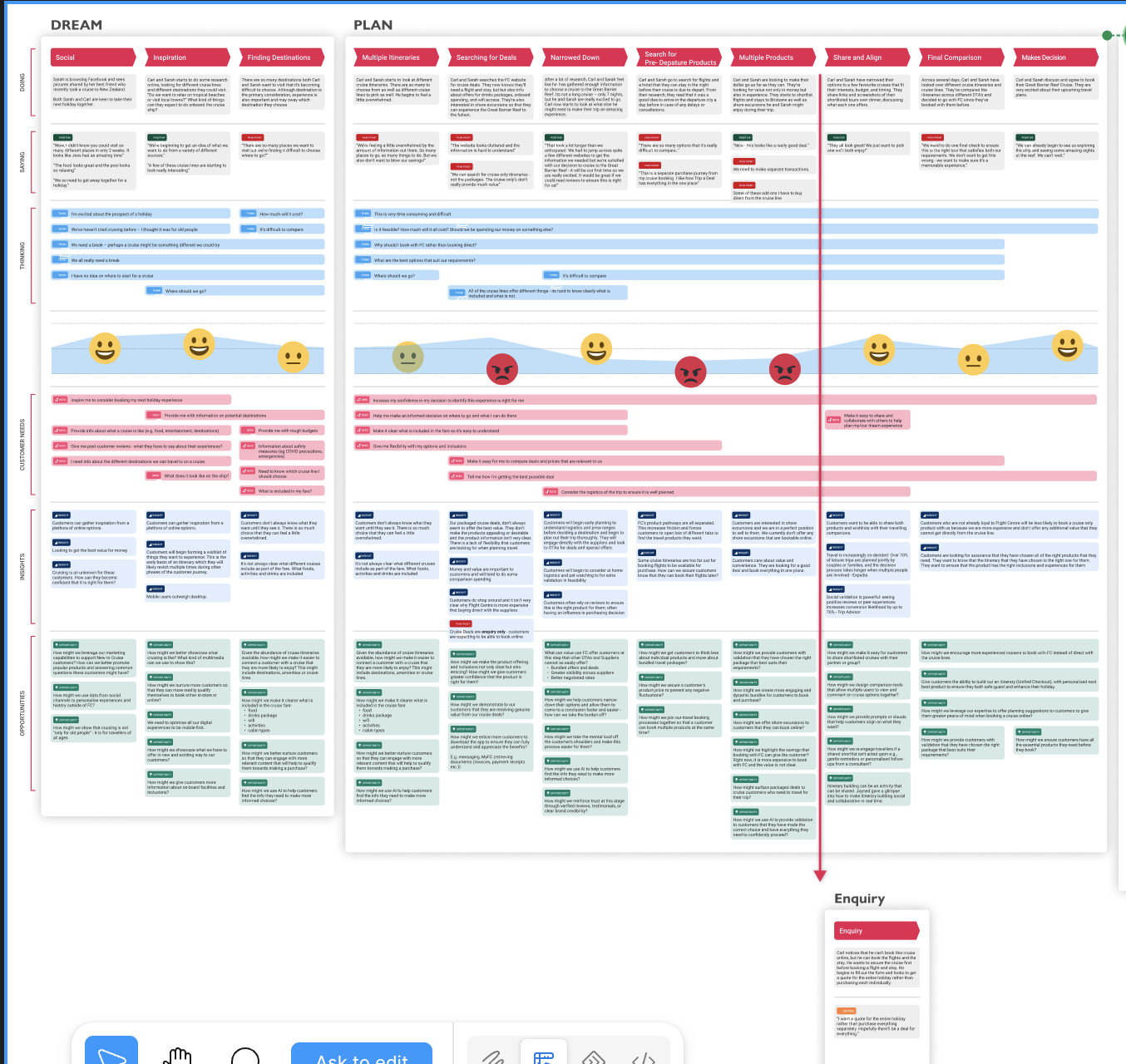
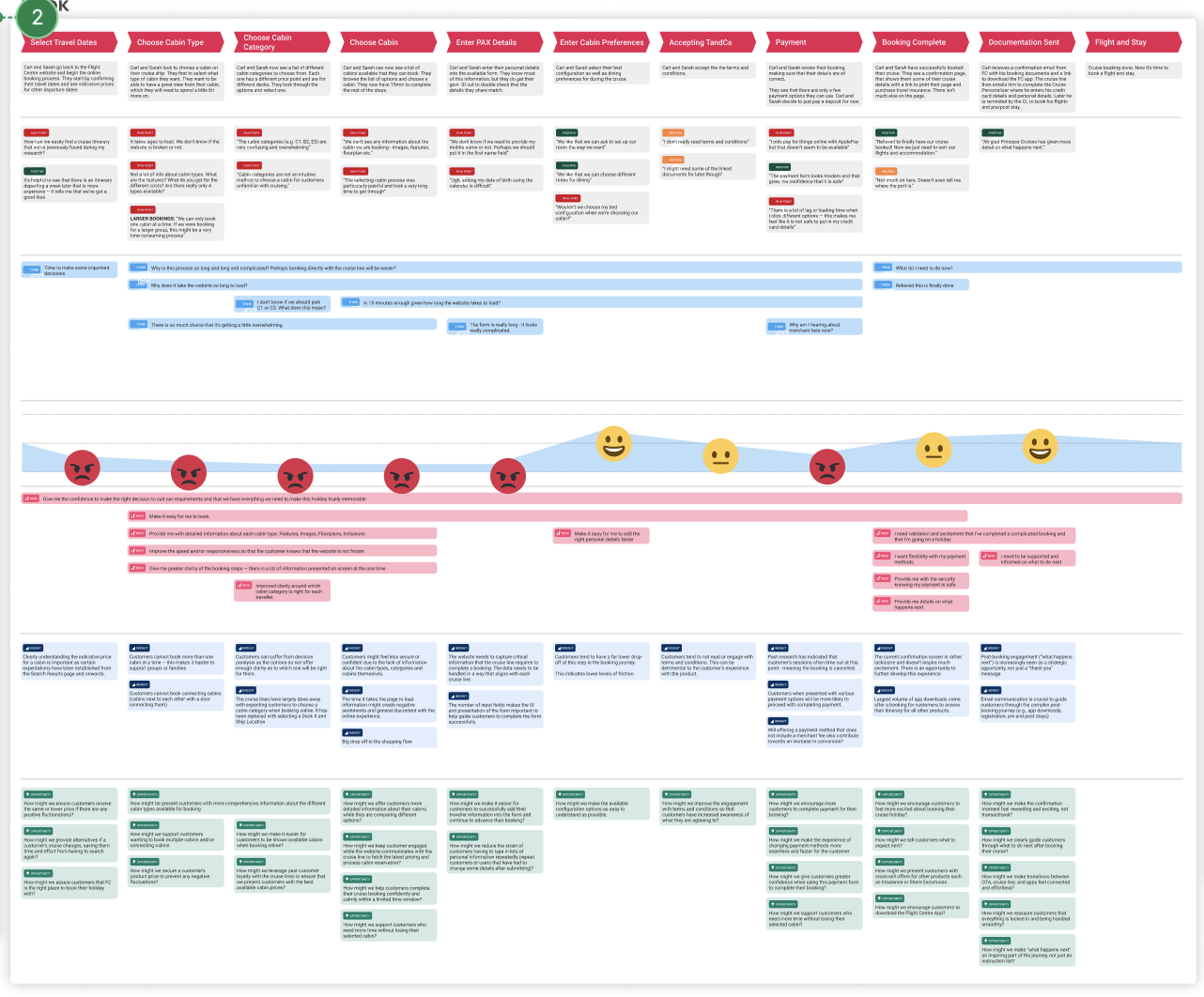
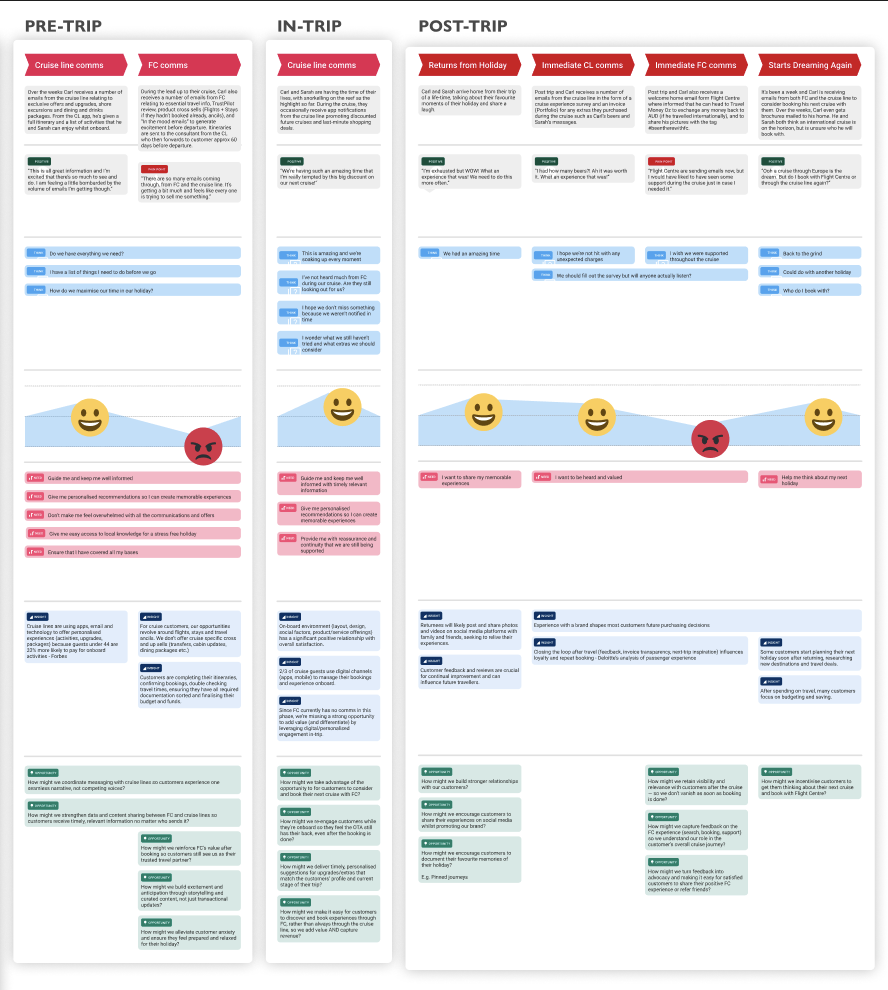
Understanding the complete customer experience
I created the customer blueprint to understand what customers were trying to accomplish throughout their relationship with Flight Centre.
For each stage, I mapped customer goals and behaviours, touchpoints, interactions, pain points, emotional highs and lows, supporting activities and opportunities.
Mapping emotion
I also mapped the customer's emotional journey.
This helped distinguish routine interactions from moments that mattered — points where uncertainty, complexity or lack of information could significantly affect confidence in the experience.
Instead of treating every touchpoint equally, we could begin asking:
Where does the customer need the most reassurance, clarity or support?
Consultant service blueprint
Looking behind the customer experience
The customer blueprint showed us where customers experienced friction.
The next question was:
Why was that friction happening?
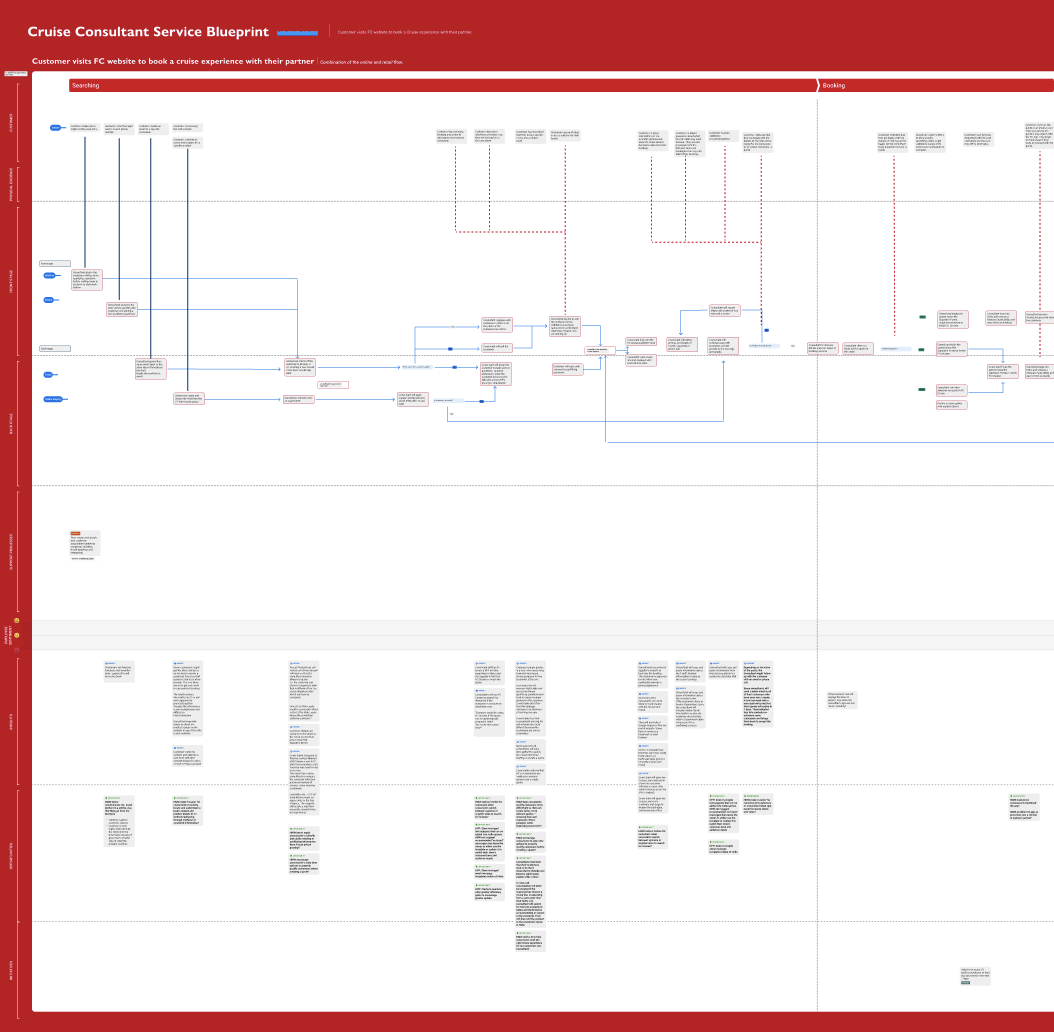
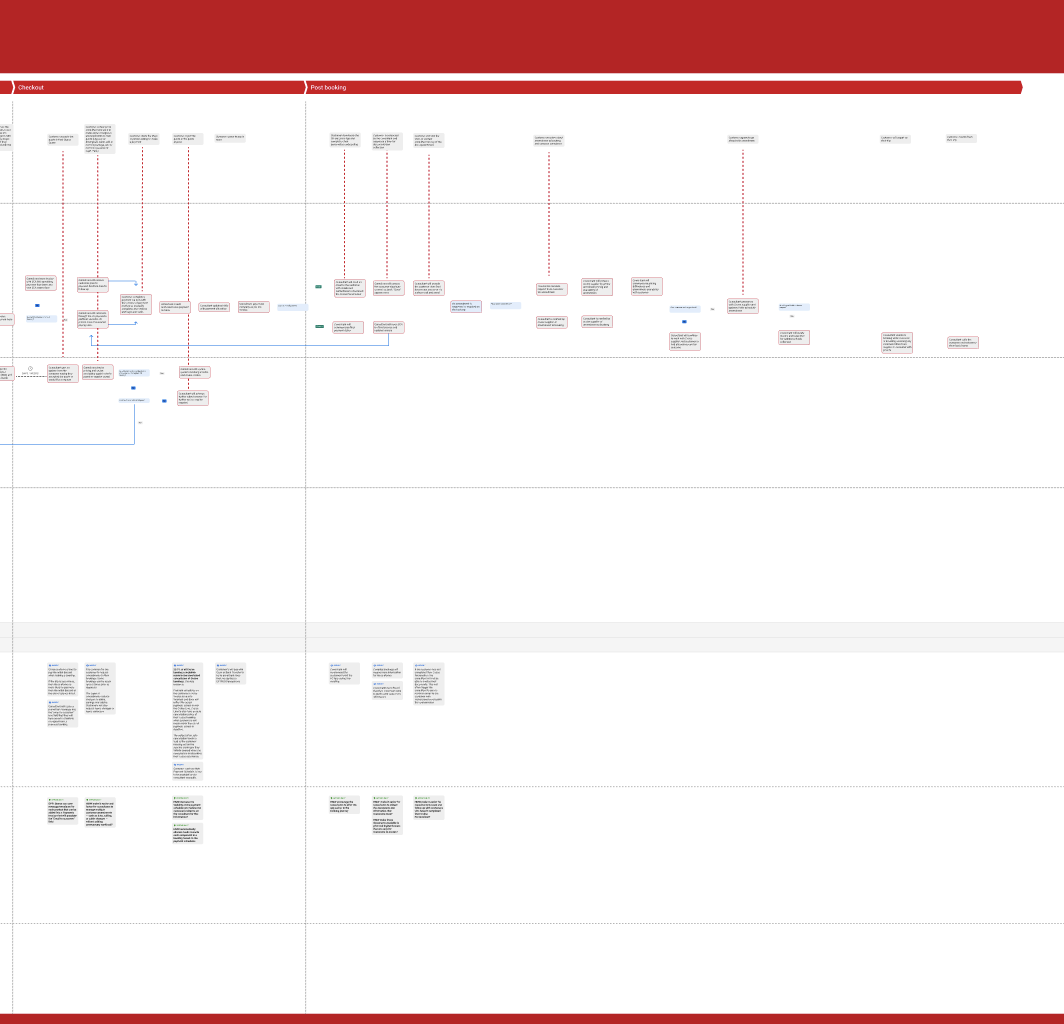
I mapped the consultant experience across:
Search → Booking → Checkout → Post-booking
This allowed us to look beneath the customer-facing experience and understand the consultant activities, handoffs, supporting processes and systems required to deliver it.
The consultant blueprint revealed that some apparently simple customer interactions depended on a much more complex network of backstage activities.
Consultant Blueprint
Connecting the two perspectives
Customer pain points often had backstage causes
The greatest value came from comparing the two blueprints.
Instead of looking at customer and consultant experiences independently, I could trace a customer-facing problem through the service to understand what might be contributing to it behind the scenes.
This changed the conversation from:
“Where is the customer experiencing friction?”
to:
“What within the service is creating that friction?”
That distinction helped us move beyond isolated UX fixes and consider changes across experience, people, processes and technology.
Key insights
1.Customers changed channels. Their context didn't always move with them.
Customers often started by researching digitally before deciding they wanted expert assistance.
From the customer's perspective, they were continuing the same journey.
Operationally, however, moving into a consultant-assisted experience introduced another handoff.
When sufficient context wasn't carried between those interactions, customers could need to repeat information while consultants spent additional effort reconstructing their needs.
Opportunity
Create stronger continuity between digital discovery and consultant-assisted booking so customers can move between channels without feeling that they're starting again.
Visual: This should be a customer blueprint crop → arrow → consultant blueprint crop.
This will be much more impressive than showing another paragraph.
2.Pricing consistency was bigger than a UI problem
Pricing initially appeared to be a customer-facing presentation issue.
Mapping the service showed that the experience depended on multiple interactions and processes rather than simply how a price was displayed on a screen.
That meant redesigning the pricing component alone wouldn't necessarily address the underlying problem.
Opportunity
Create greater transparency and consistency around pricing across digital and consultant-assisted touchpoints.
This shifted the design question from:
“How should we display the price?”
to:
“How do we create confidence in pricing throughout the journey?”
3.Booking wasn't the end of the experience
Traditional ecommerce funnels often finish at conversion.
Our customer blueprint showed that some of the most important service interactions occurred after the customer had paid.
Customers still needed preparation, itinerary information, support during their trip and assistance when plans changed.
The consultant blueprint simultaneously exposed the operational activities required to support those moments.
Opportunity
Design communication and support around the complete travel lifecycle rather than optimising only for conversion.
Aligning teams
Creating one shared view of the service
Before the blueprint, different teams naturally viewed the experience through their own part of the service.
Retail Consultants understood the realities of supporting customers and completing bookings, while the Digital Product Team focused primarily on the digital experience.
The blueprints created a shared artefact that connected those perspectives.
Together, we could see:
Customer need → Touchpoint → Consultant activity → Backstage process → System dependency → Pain point → Opportunity
This helped move conversations away from isolated channel problems toward the overall experience we wanted customers to have.
From current state to opportunities
The purpose of mapping the current state wasn't to document everything that was wrong.
It was to identify where intervention would have the greatest impact.
The work highlighted opportunities around continuity between online and consultant-assisted experiences, clearer and more consistent information, reducing duplicated effort, improving communication across the travel lifecycle and addressing backstage dependencies contributing to customer friction.
These opportunities could then inform the future-state cruise experience and product roadmap.
Blueprint Links
Outcome
The service blueprints gave Digital Product and Retail teams a shared view of the end-to-end cruise experience for the first time, connecting what customers experienced with the operational processes required to deliver it.
The work helped surface cross-channel dependencies and prioritise opportunities that couldn't have been identified by looking at the website alone.
More importantly, it shifted the conversation from improving individual touchpoints to thinking about how Flight Centre could deliver one connected service across digital and human interactions.
Reflection
What I learned
This project reinforced that customer experience problems aren't always UX interface problems.
A frustrating interaction on the surface can be the result of processes, systems or handoffs happening much deeper within the organisation.
Mapping both customer and consultant experiences taught me to look beyond individual screens and understand the ecosystem responsible for delivering them.
It also reinforced the importance of involving the people delivering the service. Consultant interviews and in-store observation gave us insights that wouldn't have been visible through digital research alone.